As quiet as I am, as often times I may accept status quo, I’m anarchic. I fight, inwardly, on how to break free, to respond to questions that some have said is not possible, too hard. And in my own writing I am trying to break free from the move towards sciences as the best purveyor of what things are and how things are.
Now, don’t get me wrong, I enjoy science. I benefit from the advances of science. I even push for its advancement, albeit with some trepidation, some apprehension as to its fruits (Facebook social networking, the loss of private data, hacking, all come from the good and bad of technological advancements). And yet, what concerns me is its sense of efficiency, which creeps into aspects in which it should not, due to its danger of cropping meaning and purpose. Maybe our mistake of technology was to think of it in its pragmatic senses, making it utilitarian, and thus it creeps back upon us that purpose and meaning become utilitarian, pragmatic, and thus removing the manyness of, yes, opinion.
So I look for breakages. Places where things are broken. Cracks. Because it is in those places where interest arises. So in my readings for my work, I came across George Steiner’s book Real Presences, where (internally of course) I am screaming “yes! this is it!” In his first section Steiner looks at the limit of theory when moving into the field of hermeneutics, language, music. To theorize means to place limits, to develop some measure so as to verify through experiment or predictive application its truthfulness (79,81).
But by what measure? Who decides? This is for Steiner the piece which breaks theory, which sets it at its limit as to its ability to enter into the aesthetic, which always breaks logic, or any measure as to its meaning. Steiner writes,
But what measure? The absolutely decisive failing occurs when such approaches seek to formalize meaning, when they proceed upward from the phonetic, the lexical and the grammatic to the semantic and aesthetic. It is this progression which no analytical-linguistic technique, however systematic its trappings, however abstruse its aspirations, has ever taken convincingly…A sentence always means more. (81-82)
This is a powerful realization, that theory is stopped in its tracks because it cannot leap the gap that imaginative inquiry can. The theory which is held by an idea is held in place, because the idea is unable to envelope itself around anything in the space of the aesthetic. I argue it is because the imaginative is meant to bring together that which cannot, while not affecting either in their determinateness. There is just too much within the possibility of images and language to contain it within an idea or even a methodology that is universalizing. There can be no science or theory to meaning because the finite aspects that we grasp produce limitless possibilities. Steiner writes,
an object, the description of whose formal components can be finite, demands and produces infinite response…the manifold of possible meanings–and the category of the meaningful is too static when applied to the poetic–is the exponential product of all possible sense or non-sense worlds as these are construed, imaged, tested, indwelt through the interaction of two liberties: that of the text, in movement across time, and that of the receiver (83).
The poetic, the image, the imagination, they each bring forth from intuition, and only from that emergence can there be any form of interaction with it. The intuitive feeling and trace of the image, of writing, of music, of language, are to be experienced, and then only analyzed. But truth is not what is to be sought, but meaning. And meaning breaks smooth logic and truths, because meaning indicates that there is a life that is seeking its actualization (see Deleuze, Pure Immanence)
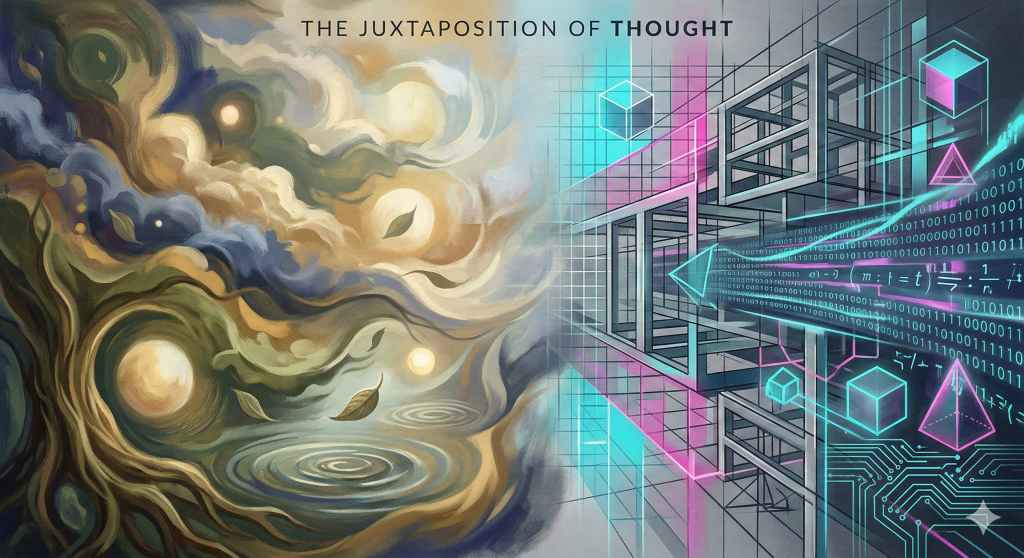
The poetic is important. It forces a progression and a break; it introduces questions that force us to once again deconstruct and reconstruct our prior held notions. But it is not meant to go against science itself, but to make both realize that each does not contain the fulness of the things in themselves. The imagination may allow for the emergence of things to come forth, but the sciences in all its fullness is important to line up possibilities of how it becomes.
Thus, my (inward, moving outward) anarchy is meant to reveal that no smooth lines really exist. There are breakages, cracks in things, which bursts bubbles and breaks us out of the norm, to what is possible. This can be done in sciences, or religion, in philosophy or anything else. Our precision analytical capabilities cannot show us all of reality, but must be made to fit within it (see Alfred North Whitehead, Aims of Education)



 Process Imagining
Leave a comment