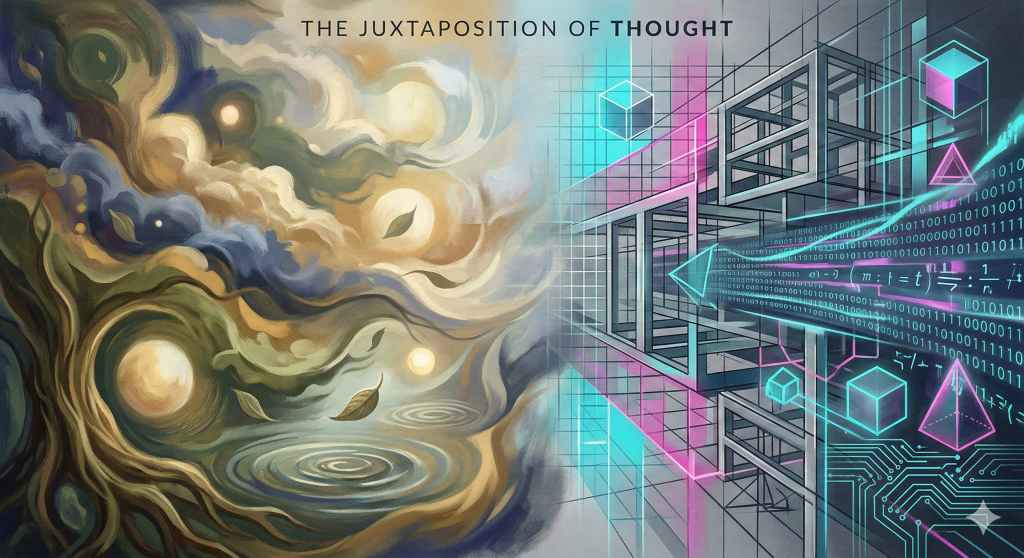
A lot of my thinking and writing is on the role or epistemological function of the imagination, that which allows us to perceive the world around us, and able to feel without experiencing, structuring a possible world from what we see before us. Imagination does something with what we perceive with the world and enjoys the process of its own becoming in the pursuit of knowledge and meaning.
Part of this came from my professor and mentor Roland Faber’s teaching of Schonberg’s Moses Und Aron, which depicts the dilemma Schonberg himself had in contemplating in his work “how we can speak of the ultimate?” This is a difficult task because when we conceive, we conceive by taking what we have before us, assemblaging and constructing things into something new. We imagine its becomings. The struggle for Schoenberg is here evidenced in the discussion of Moses and Aron in scene 2 of the opera:
**Aron:** O vision of highest fantasy, how glad it is that you’ve enticed it to form you.
**Moses:** How can fantasy thus picture the unimageable?
**Aron:** Love will surely not weary of image forming. Happy is this folk to revere its God so!
**Moses:** Folk set apart to know the ever unseen one, to reflect on greatness unimaged.
**Aron:** Chosen is this folk, thus to love one great god ever and ever, with a thousand times more devotion than all other earthly peoples for their many godly beings. Not be seen, not imagined. Folk chosen by the only one, can you worship what you dare not even conceive?
**Moses:** Dare not? Not conceived because unseen, can never be measured, everlasting, eternal, because ever present, and almighty. The one God is almighty.
How do we conceive that which is unimaginable? Aron’s response is with emotion and feeling. Aron uses the word love, vision, fantasy, as three parts that births within the self that which cannot be conceived, but taking what we have and making knowable what can be known. This is the difficulty. Whitehead speaks much about the notion of relations, and that without relations there can be no-thing. Thus there is a synchronicity among these three that allow for the manifestation for images. I would even argue that the imagination is a space, a lure, for which love, fantasy, and vision are allowed to be and create. Because these three create the actuality that we witness, while it removes itself from the actual thing.
The question always remains about the desire to remove that which is the image, while there cannot be anything without an image. There can be no creatio ex nihilo, but must have a creatio ex profundis (See Catherine Keller’s Face of the Deep). The deep is a pure multiplicity, all things, in which, in Deleuzian terms the virtual as a web across, not limiting, but allowing for the creation of the real made possible to form, cutting across, so that in the actual there is a life. I would argue this is the imagination, the creation of images, the work of love, fantasy and vision.
The unimaginable therefore would be a matter of the notion of time. Because once we experience the divine, the divine is in the making, from the feelings of awe, love, derive visions and fantasy, fantasy being the most awesome one can conceive of the divine, even to the point of foolishness. From this one is able to conceive through language what needs to be articulated.
I will need to write/think more on this….



 Process Imagining
Leave a comment