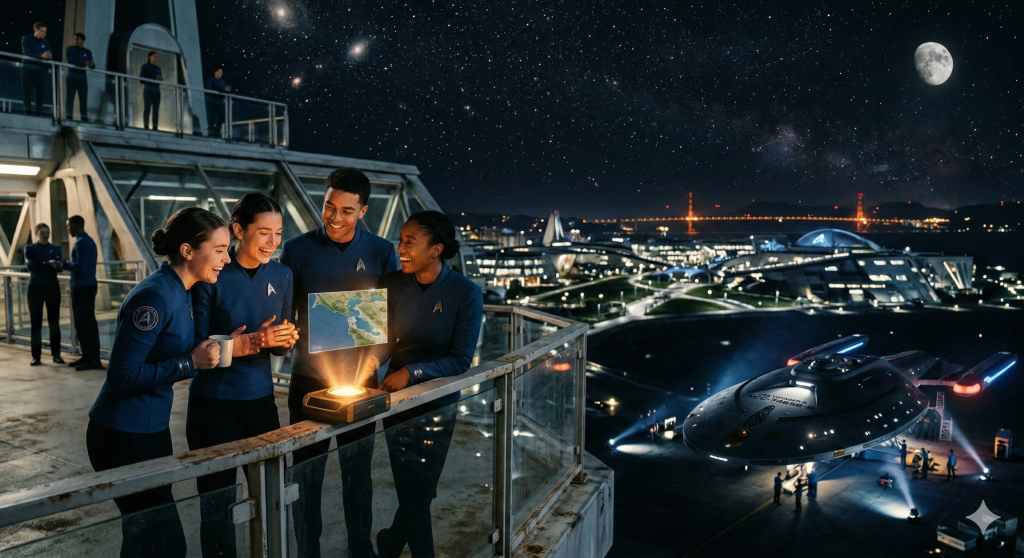
Although the latest Star Trek series, Starfleet Academy, has its detractors, I have found a profound sense of hope for the future in watching it. The show thoughtfully engages with questions that navigate the space between multiplicity and singularity, the many and the one—contrasting the vastness of the universe with the particularity of one’s own context.
One episode in particular (S01E08) impacted me so deeply that I felt compelled to commit it to digital paper. It beautifully articulates this very tension, observing:
“We exist in an era defined by our capacity to reach outward. We engineer astonishingly sophisticated tools to traverse the stars, mapping the infinite expanse of the universe with ever-increasing precision. Yet, a profound paradox remains at the heart of our exploration: the technological mastery required to travel the cosmos offers absolutely nothing to help us make sense of it. How do we derive meaning when faced with the cold, silent vastness of space?”
Ultimately, this passage suggests that meaning is not passively discovered out in the abstract infinity of the universe, but is rather actively forged through the mundane, temporal realities of lived experience, relational connection, and the painful process of becoming.
The Irreversibility of the Event
To understand how we construct meaning, we must first confront how meaning is disrupted. When catastrophic events happen, they irrevocably change the very ontology of our reality. An event acts as a rupture. The meanings, assumptions, and structures that governed our lives prior to the trauma are shattered. We are faced with a stark truth: we can never go back. The past is sealed off, and the attempt to return to a prior state of innocence or equilibrium is an illusion.
However, while the past cannot be inhabited, it provides the essential reservoir from which we draw to figure out our present. It gives us something to delve into and interpret. We are compelled to move on, but moving forward requires us to synthesize the rupture into a new framework of understanding. This synthesis is the essence of resilience—the profound ability to withstand and recover from differences, hardships, and the alienating shock of the new.
The Necessity of “Becoming” and the Crisis of the Artificial
The nature of this resilience is explored through the crisis of Series Acclimation Mil (SAM). SAM serves as a tragic mirror to the human condition precisely because she lacks the fundamental human experience of temporality. Brought online as a fully formed entity, SAM’s species has no need for a childhood, no requisite period of maturation, and no time allotted simply to grow. They are, but they do not become.
When SAM is exposed to the trauma of events, the myriad differences of the Starfleet species, and the sheer weight of organic suffering, she begins to overload. She is incapable of coping because she possesses no ingrained mechanisms for processing grief or shock. Human beings, by contrast, are defined by their requirement for time passing. We are not born with wisdom; we sediment it over decades of development. The slow, often painful unfolding of childhood and adolescence is not a design flaw, but the very mechanism by which we learn to navigate a chaotic universe. Because SAM lacks this temporal history, she has no internal scaffolding to support the weight of her experiences.
Her narrative reveals a truth about resilience: it cannot be instantly downloaded or engineered. It requires an intersubjective intervention. For SAM to recuperate, she cannot be left in isolation. It requires that someone step into the breach—someone to come alongside her, to raise her up, to offer advice, and to serve as an anchor. The Doctor must essentially provide her with the prolonged developmental period she was initially denied, proving that consciousness without the grounding of time and relational care is inherently fragile.
Relational Scaffolding and the “Found Family”
This theme of intersubjective reliance extends seamlessly to the Starfleet cadets. In the wake of their own irreversible traumas, the cadets find themselves unmoored. The structures they previously relied upon have been compromised. Yet, it is within this shared vulnerability that a new path forward is forged.
The cadets must look beyond themselves and beyond their immediate, biological families to find the strength to process their reality. They use one another to build a new architecture of belonging. These friendships, cultivated in the crucible of shared hardship, become the very vehicle through which they break away from the paralysis of their trauma. They discover that true resilience is rarely a solitary achievement; it is a communal act. By leaning on one another, sharing their disparate histories, and engaging in the messy, relational work of empathy, they manage to find meaning and purpose anew. They do not erase the event that changed them, but they integrate it into a shared, collective narrative that allows them to flourish.
The Mundane as the Anchor for the Infinite
Ultimately, this search for meaning is encapsulated by the cadets’ engagement with Thornton Wilder’s play, Our Town. In an academy surrounded by the most advanced technology imaginable, it is a simple play about the ordinary lives of a small, early 20th-century community that provides their salvation. Our Town serves as a reminder that the vastness of the universe is incomprehensible without a localized point of reference.
It is in the quiet, repetitive mundaneness of life—the daily routines, the small interactions, the passing of seasons—that we actually develop purpose. The play directs our attention away from the dizzying expanse of the stars and back toward the profound beauty of ordinary, temporal existence. In the face of infinity, it is our reliance on the past, our submission to the slow passage of time, and our deep, abiding connection to one another that ultimately make sense of the universe. We do not conquer the cosmos by looking outward with sophisticated tools, but by looking inward, responding with respect and awe to the beauty of the things, and the people, right in front of us.



 Process Imagining
Leave a comment