Who I Am
My fascination with philosophy and religion is rooted in their power to shape lives—not just in the abstract, but in the concrete realities of human existence. As a scholar and practitioner, I am drawn to the intersection of Continental thought and Process philosophy, specifically the movement toward differentiation and harmony.
My work is an exploration of the topography of the imagination, a term I borrow from John Sallis. I am not merely interested in ideas as tokens, but in the “elemental” forces—nature, earth, and spirit—that precede our logic. I view the academic and the personal as a singular trajectory: an effort to rationalize the “mysticism” of experience into a framework for shared flourishing.
About Process Imagining: Rethinking Philosophy, Culture, and Religion
Process Imagining is an exercise in radical re-envisioning. Drawing on the trajectories of Whitehead, Deleuze, and Sallis, and informed by Vilém Flusser’s critique of the digital age, I posit that all of life is defined by radical relationality.
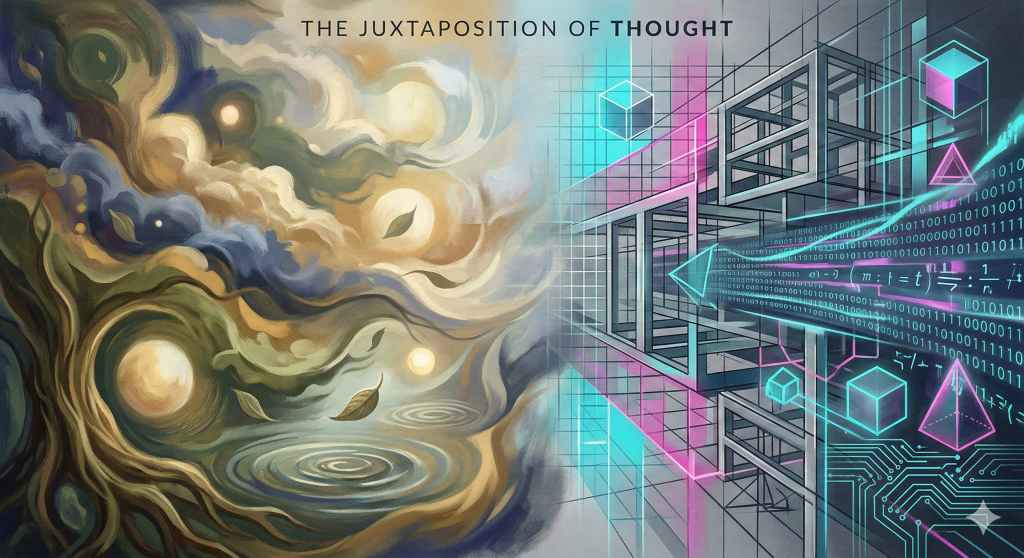
Consequently, every category of our existence must be called into question. The world around us—particularly the “virtual” world of economics and technology—is built upon a substance-based metaphysic. These established systems attempt to function as a “perfect dictionary,” claiming to contain the totality of how the world works. But life, in its fluid intensity, always exceeds the dictionary.
The Failure of Static Systems
The systems that “make the world turn” are rarely the ones we utilize in our concrete, intimate lives. We live in a world dominated by apparatuses—automated systems of bureaucracy and technology that Flusser warned would turn us into mere functionaries.
The Enlightenment agenda has failed because it attempted to turn the world into a “black box”—a system where we know the input and output but lose sight of the internal process. As Sallis suggests, the “shimmering” of the world—its constant movement and refusal to stay fixed—is what these static systems try to suppress. When we treat life as a static substance, we lose the force of imagination that allows for true novelty.
The Novelty of Ideas
The core of this project is to instill a sense of novelty. As Whitehead noted, the use of philosophy is to “maintain an active novelty of fundamental ideas illuminating the social system.” It is a reversal of the slow descent toward the commonplace.
In an era that Flusser described as “Post-Historical”—where we are at risk of being swallowed by our own technical images—the task of philosophy is to regain our agency. For Whitehead, Deleuze, and Sallis, the goal is not the rigid logic of “If/Then,” but the formation of possibilities. It utilizes logic as a lure for feeling—using mysticism and poetry to express the heights of civilization.
Toward a Philosophy of Belonging
The Metaphysics of Inclusion
In a substance-based metaphysic, we view individuals as isolated “things.” In Process Imagining, we shift this lens: we are a series of actual occasions—a flow of experiences defined by our relations. Belonging is a topography of gathering. Informed by Sallis’s focus on the “elemental,” I view inclusion not as a policy, but as a recognition of our shared ground.
Restorative Imagination
If the world is built on radical relationality, then injustice is a rupture in the web of existence. My approach to Restorative Justice is the practical application of the “lure for feeling.” In Flusserian terms, it is the move from being “functionaries” of an institution to being “players” in a shared creative process. We move away from the logic of the apparatus and toward a logic of value, where every unique “imagination” is a shimmering contribution to the whole.
The Sacred Process
At the intersection of theopoetics and social strategy, we find that the “divine” is the lure toward greater complexity. By rethinking our philosophical foundations, we transform the classroom, the boardroom, and the community into spaces of poetic dwelling rather than mechanical repetition.
The Path Forward
ProcessImagining.com is a record of how I see the world, how I have been shaped by past actual occasions, and how I prehend them to form the present and future.
“Philosophy is the transition from the commonplace to the novel. Belonging is the transition from the isolated to the integrated.”




 Process Imagining